
Brusselator - Pond’ring Aloud
2026-01-29

brainstorming, thinking aloud, this isn’t consistent and I reserve the right to change my mind:
When I think of The Game of Life, I don’t see “equations”, I see “algorithm”.
When I look at the 4 “rules” of a Brusselator, I see “algorithm”. I am surprised to see the piles of math and time derivatives. That pile of math looks much more complicated than it should be, in my simplistic view.
If I understood Nobel laureate Prigogene’s complaints in the first 100 pages of Order Out Of Chaos, he was describing an irreversible reaction which, when treated in a “functional” manner isn’t irreversible any more (in my words, the passage of time is ignored), or, at least is so over-loaded with notational details as to be confusing and unhelpful.
Is there an “algorithmic” version of the Brusselator?
k1: A -> X
k2: 2X + Y -> 3X
k3: B + X -> Y + D
k4: X -> E
A and B are constantly added.
C and D are constantly removed.
(Huh? What is C? Maybe that E should be C? More reading required on my part…)
What I see is a Ceptre-like algorithm
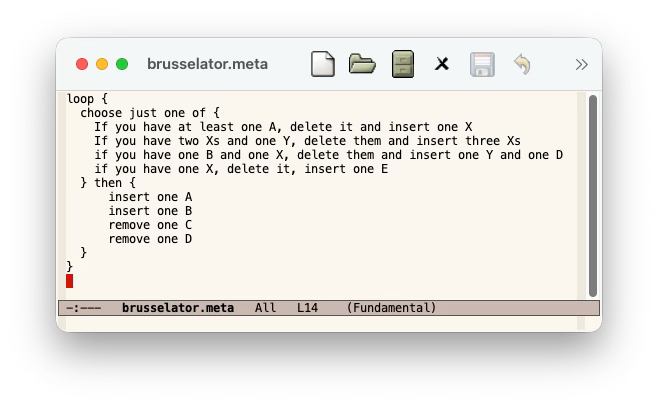
Ceptre uses “linear logic” which allows for more than one of the same kind of thing in the factbase. E.G. in (2), “at least one” means that there might be more than one A, but the rule says to convert only one of the As.
[N.B. I still don’t know what C is.]
See Also
Email: ptcomputingsimplicity@gmail.com
Substack: paultarvydas.substack.com
Videos: https://www.youtube.com/@programmingsimplicity2980
Discord: https://discord.gg/65YZUh6Jpq
Leanpub: [WIP] https://leanpub.com/u/paul-tarvydas
Twitter: @paul_tarvydas
Bluesky: @paultarvydas.bsky.social
Mastodon: @paultarvydas
(earlier) Blog: guitarvydas.github.io
References: https://guitarvydas.github.io/2024/01/06/References.html